Despite India's impressive economic growth over recent decades, the country continues to face challenges of poverty, illiteracy, corruption, malnutrition and terrorism. Approximately 70% of the country lives on less than U.S. $2.00 a day. Yet, India is a home to over 3 million NGOs. Many of these leaders are working tirelessly to improve the social conditions of the country.

"Introduction to Social Entrepreneurship: A Case Study of India" will challenge students to confront more advanced issues faced by today's social entrepreneurs. The field experience of the course will take students to Mumbai and India. Students will meet Social Entrepreneurs and NGOs working at all societal levels to understand grassroots' needs as well as the overall public health infrastructure in India.

Showing posts with label Dharavi. Show all posts

Tuesday, August 09, 2011

Day 3. Dharavi

After our yummy breakfast we headed to another slum, Dharavi, to learn about waste management. Dharavi is often described as the largest slum in Asia, housing close to 1.5 million people (!). On the way there we picked up Vinod Shetty, director of ACORN India. This organization educates rag pickers and trains them in scientific methods of waste handling, segregation and recycling (Note: rag-pickers are those who pick up the tons of garbage littering the streets in Mumbai in order to recycle them. Most of them are women and small children).


I was not sure what to expect from Dharavi. In my mind I thought it was going to be very similar to the first slum we visited, extremely impoverished and somewhat hopeless. The idea of an organized waste management system in a slum was something my mind was having a hard time comprehending. We got off the bus and followed Mr. Shetty along muddy alleys and narrow roads to visit the many waste recycling sites.

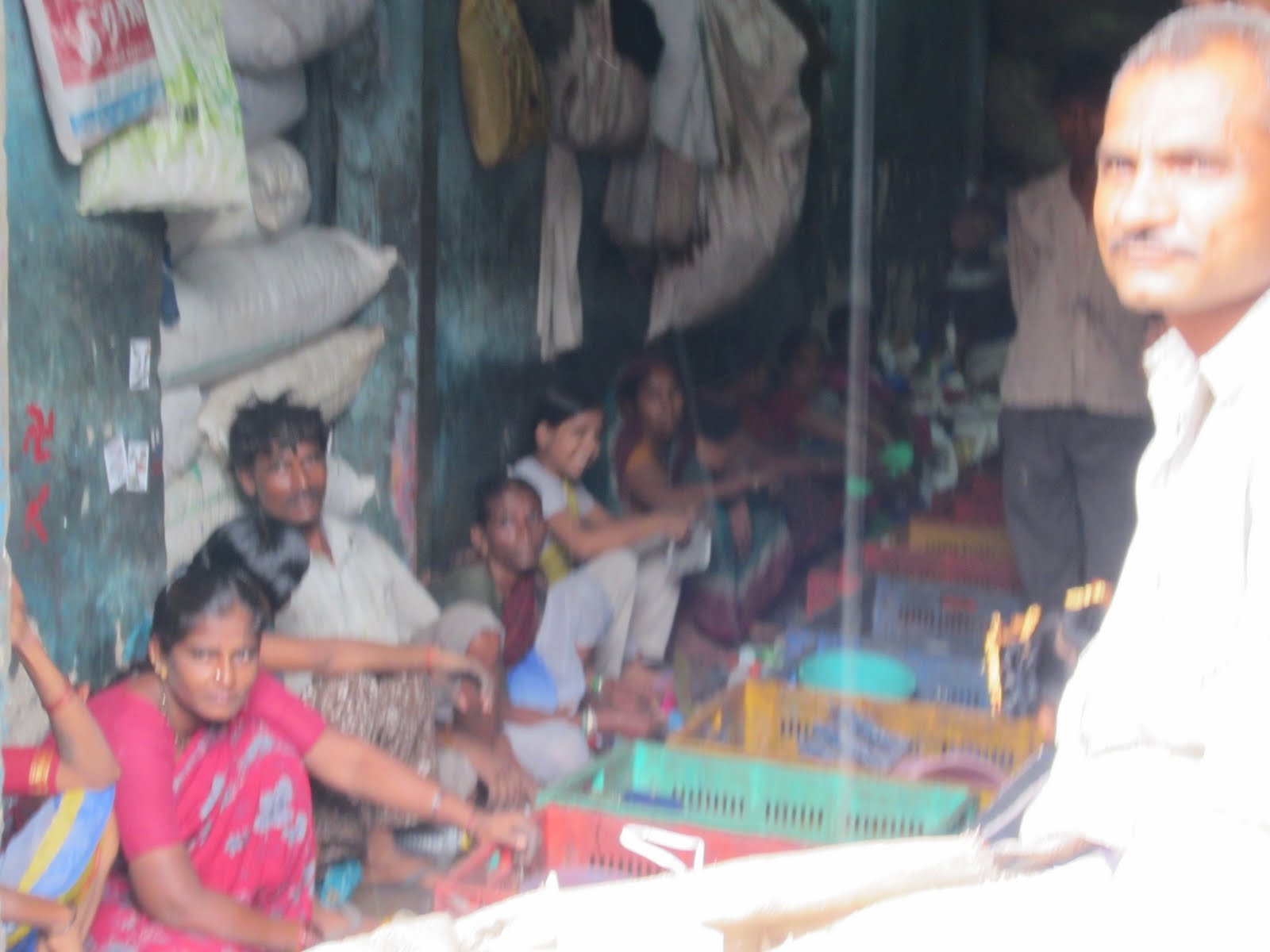
I was very surprised to see so many men working in these small and crowded shops, recycling cardboard, plastic, metal from car parts, and a myriad of other things I can’t even remember. The rag pickers collect all the recyclable materials from the garbage around the city, bring it to these shops were they get processed and then sold to either paper or plastic companies for a very small profit. The men not only work, but also live in these shops, making the system sustainable. You’d never imagine to see a system like this in a crowded slum were most (if not all) people lack basic needs and most live on an income of $2-3 per day. Despite there being some level of organization and an income generating system, workers still work in precarious conditions (barefoot, no eye/hand/ear protection), and the money earned from the Dharavi recycling industry will never allow these people to move out of the slums or improve their life and health conditions. As impressed as I was with this slum, the current system is never going to allow social change.


Once again, what being done is not enough to help the community of Dharavi. My mind is still trying to comprehend the idea that earning an income is not enough to fight poverty. Earning a few dollars a day will not improve the lives of future generations. A sustainable system that allows the community to set solid foundations (ie. access to education, health care, stable incomes) will enable the change that is needed.

Monday, August 08, 2011

Dharavi

Late last week, our group visited Dharavi, which is one of the largest slums in Asia and called home by over 1.5 million people. This particular slum was made famous by the movie Slumdog Millionaire; however, what was depicted by the movie only shows a sliver of what this vibrant community exists as.

We were led through Dharavi by Vinod Shetty at Acorn India. Mr. Shetty eloquently and comprehensively explained all of the ins and outs of Dharavi, specifically with relation to the functioning industrial community that exists within the slum. It truly is a city within a city, and is currently under scrutiny and threat from the Indian government.

Dharavi lies almost directly in the middle of Mumbai – a very valuable and desirable location for development. Only a few weeks earlier, blocks and blocks of Dharavi were bulldozed announced by the government in a display that not only ruined homes and businesses, but also flexed the government’s muscles with regards to their influence on the pending development of Dharavi. Suffice to say that moving forward with this redevelopment would undoubtedly leave hundreds of thousands, if not millions, of people displaced and put an end to a thriving industrial community that currently exists.

Under the guide of Mr. Shetty we were able to see firsthand how the residents of Dharavi have taken very little and turned it into quite a lot. These people recycle everything that can be re-used and then make their living from these products. Recycled car parts, dishwashers, glass pieces and just about any other large recyclable can be seen on the outskirts of the slum. Walking a few meters inside, we were exposed to veritable factories that are turning out recycled cardboard boxes, plastic drums, paper products and other necessary goods that are then sold to other businesses. It is in this way that the people of Dharavi have truly made something great, out of nothing.

In this same vein, Acorn India is doing the same for many of the children of Dharavi. Unlike the images seen in the movie Slumdog Millionaire, I did not witness children running wild in Dharavi. When we visited Acorn’s offices, half of which were destroyed in the government razing, we were introduced to Abdullah and Hussein. These two young brothers were part of the Dharavi Rocks! Program which aims to provide empowerment and self-worth through music and theatre education. The boys were gracious and welcoming, and responded excitedly when asked for an impromptu concert. This experience really gave meaning and proven value to the outreach program Acorn India is conducting. It made me think that some of the issues faced by these boys maybe aren’t so different than some faced by children in the United States. True, the geography and resources are vastly tilted in the direction of the United States; however, encouraging confidence through musical education is something that many children all over the world can relate to.

After our day together, Mr. Shetty asked us to follow up with him with regards to what we thought were the most important public health issues that Acorn India was either doing well in, or could use a bit more work towards. One of the most serious threats to human health I witnessed are the occupational hazards inflicted upon workers. On numerous occasions I saw men covered head to toe in dust and/or paint, workers were spending days in humid rooms with no ventilation sorting through mounds of dusty paper products. My picture of this can be seen in Charlotte Hager’s earlier blog. In Dharavi, sparks fly through the air with workers wearing no eye, ear or face protection; workplaces exist in the same breath as goats, insects, rodents and trash. Our Environmental and Occupation Health Professor would certainly be more than alarmed at the conditions that the men and women of Dharavi experience.

With countless NGO’s working in Dharavi, it is shocking to me that none of them appear to be addressing this issue – at least not on a level that we witnessed during our time there. The focus is, undoubtedly, more attuned to reproductive health, STD/STI screening, HIV/AIDS awareness and testing and perhaps nutritional concerns. From a public health student’s perspective, it almost seems that the EOH side of health is overlooked – not only in a slum in India, but perhaps also in America. Might it be that at home we don’t equate the workplace precautions we take for granted as protecting our health? Perhaps no parallel importance is put on knowing your HIV status, as well as making sure your lungs are safe from respiratory dangers in the workplace.

When I write to him, I will let Mr. Shetty know that the area in which I believe there can be the most improvement for the workers living in Dharavi is in with regards to their occupational safety. Perhaps this will pique an interest for Acorn India to potentially partner with a construction agency or health agency to bring in eye protection, ear plugs or personal air ventilators. If one industry could donate 1,000 hard hats to workers, it could make all the difference.

I hope that this blog, and the other sentiments and pictures shared here, will expand beyond our community of family, friends and colleagues so that the “real” Dharavi can be understood by those who might think that it, and all of India, is only as seen in the movies.


your trash lines their streets

08.04.11

Our journey this day sent us to Dharavi - the largest slum in Asia. Consisting of 1.5 million inhabitants, mostly male migrants forced to leave home in search of money to help them and their families survive. I'm still not sure my thoughts from this mind-boggling day.

I am going to try to sort through my thoughts in a different way than normal - beyond words. I feel like images are more powerful than any description I can provide. Given I am still not sure my thoughts on Dharavi, perhaps it is best to stay impartial.

Acorn Foundation India and their Dharavi Rocks project are phenomenal - without a doubt. But the reality of life in Dharavi presents many questions for me: what are human rights, government rights, land rights, occupational health hazards, public health nightmares, child labor restrictions, sex worker rights, drug usage realities, expected crime rates - and of course - environmental concerns of waste management? Not to mention the piercing question still ringing in my mind: has India become desensitized to poverty? Are the inhabitants of Dharavi endowed the right of land and a space to work in in order to survive, or are they merely squatters on government property intruding and refusing to cooperate? I don't know.

For right now, I will leave you with powerful photos shared by my colleagues Brooke Stein and Jenn Queen. In an attempt to show respect to the community (aka not treat them like a tourist attraction) some of us students left our cameras on the bus so there'd be minimal stop.click.flash moments. Thank you ladies for letting me reflect upon my impressions of Dharavi from behind your lenses.


Abdul and Hussein.

Day 3 – Dharavi –


Today we were welcomed by Abdul and Hussain, two boys who live in Dharavi who happily shook our hands and welcomed our large group to their home. They are beneficiaries of The Dharavi Project. They played on recycled drums and sang to us in the Acorn office inside of Dharavi. It was so beautiful and so full of emotion.


Dharavi is the slum district that was highlighted in the award-winning film, Slumdog Millionaire. Except the real Dharavi wasn’t what we saw in the movies. Dharavi, a slum that spreads over Bandra, Sion, Kurla, and Kalina, is home to approximately 1.5 million people.


En route to Dharavi, we stopped in Bandra and picked up Vinod Shetty, Director of Acorn Foundation, a charitable organization that is the umbrella for the Dharavi Project. The Dharavi Project "is a multimedia project that utilizes artists and social-impact programs to change the living conditions" of the 'rag-pickers' who pick up waste in and around the landfills of Mumbai. Abdul and Hussein have had the opportunity to work with bands who are affiliated with the Dharavi Project.


Dharavi, one of the largest slums in Asia, was mind-blowing. The slum that houses these so called “rag-pickers” help Mumbai’s economy thrive. These 'rag-pickers' hunt all throughout Mumbai picking up any tiny little piece they can find to bring back to Dharavi that can potentially be recycled. These pieces are then organized or separated into larger categories and then re-cycled and sent back to into town.


In one instance, we saw a family put together cardboard boxes and in another put together car fenders to send to the car shops. The area was PACKED with recycled car seats, games, cardboard, drums, cans, bottles, material, globes, car fenders, and everything and anything else you can imagine that can be recycled. Places that were 300 sq feet, big enough to house five people and house your factory of either dying material, or making cardboard boxes, or fixing car fenders. You live, eat, sleep, and work all within 300 square feet (or less).


And occupational safety -- Who needs that when you just use your bare hands and feet? Men working with car pieces were not wearing gloves. Women using dye for clothes were not wearing masks. Children were running bare foot in the mud.


In the midst of all this recycling and mill work was everyday life - Barber shops, vegetable and fruit stands, temples, mosques, and people "guppshupping" (small talk). Yet, I cried. I was so full emotion that day to see so many people and so many children work so hard for a nearly $2 a day.

For the last two days I haven't stopped thinking about Abdul and Hussein and how their childhood is stripped by assiduously working all day in unhygienic and unsafe conditions. What seems mundane and normal in my life when I was 9 years old is something they will probably never know or see. It seems so incredibly unfair to me. It makes me somewhat at peace to know that NGOs and projects such as the Dharavi Project exist - that empower these individuals to better life through art, music, theatre and language. But then I take a step back and think, will life always be like this for them and for their children? We definitely do know that the Slumdog Millionaire will probably not be the reality for the remaining 1.5 million individuals.


Nitasha

Thursday, August 04, 2011

“Creating wealth out of nothing”


Today we had the pleasure of meeting with Mr. Vinod Shetty of ACORN India who showed us around Dharavi, the slum made famous by Slumdog Millionaire. Unlike its portrayal in the movie, Dharavi is comprised of millions (1.5 to be exact) of industrious and creative people and hundreds of thriving enterprises that are truly “creating wealth out of nothing,” as Mr. Shetty said.

Our walk through Dharavi was a mind-blowing, humbling, thought-provoking, sensory overload. I found myself fascinated by the distinct industries and processes represented in each “hut” we passed. We spent much of our time in the recycling district. There is really no formal recycling industry in Mumbai because, as Mr. Shetty said, the economics just don’t work. So “rag-pickers” around the city bring garbage to Dharavi’s recycling centers, which have grown up over decades. Individual enterprises throughout the district handle various types of materials and parts of the recycling process. For example, in one multi-level building men disassembled cardboard boxes, fixed them with staples, and reassembled them for sale to small businesses. In another, women and men sat crossed legged in front of multi-colored bins, sorting small pieces of plastic to be grinded down to powder. The sorters could determine the chemical makeup of the plastic just based on the weight and feel.

But recycling isn’t the only industry in Dharavi. We also saw dye shops where people were making fabrics, welding shops making metal products, and people hand weaving brooms. And there were services to meet the workers’ needs – everything from convenience stores and restaurants to barber shops.

While the people of Dharavi have, over the last 75 to 100 years, created this huge economic engine, it is of course not without problems. Looking at it with a health lenses, we could not help but notice the occupational hazards everywhere. Men were welding and grinding metal without eye protection, gloves, or earplugs. People, including children, were touching dirty, potentially contaminated recycling materials without gloves. And workers were crouched in one spot, working with little light, for long periods of time. Beyond occupational hazards, there was abundant pollution, fruit covered in bugs being sold on the streets, and children running around barefoot. The government had recently demolished a large section of the slum that ran overtop a water pipeline, supposedly in an effort to avoid water contamination. However, they had left the oil and chemicals and garbage strewn on top of the pipes and it had a putrid smell coming up from it, so it did not seem safe at all. We smoke with Laxmi, one of the women features in The Real Slumdogs, National Geographic documentary we watched in class, and she explained how she had suffered from asthma right after the demolition.

ACORN India is doing great work to correct some of the problems in Dharavi. It works to educate workers about safety precautions they should take to avoid injury and chemical poisoning. It also provides children of Dharavi – many of whom must work to help feed their families – with educational opportunities including English classes, computer training, and even music lessons. Two boys from the ACORN program played drums for us, using recycled goods including plastic tubs as instruments. Perhaps most importantly, ACORN advocates for Dhavari citizens to protect them from injustice and abuse from the government and corporations. While as we discussed in a class meeting later, ACORN is not a true social enterprise, it is delivering valuable services that will hopefully help the next generation of Dharavi by educating children. I was truly humbled in meeting Mr. Shetty and hearing about the tremendous effort he and his small team of volunteers are making in Dharavi. Our glimpse into the real Dharavi is an experience I will never forget.

Here are some photos I took today.

The water pipeline and potential contaminants:

A recycling shop, that's a stack of old car bumpers:

The plastic sorters:

The ACORN boys playing drums and singing: