Today we had the pleasure of meeting with Mr. Vinod Shetty of ACORN India who showed us around Dharavi, the slum made famous by Slumdog Millionaire. Unlike its portrayal in the movie, Dharavi is comprised of millions (1.5 to be exact) of industrious and creative people and hundreds of thriving enterprises that are truly “creating wealth out of nothing,” as Mr. Shetty said.
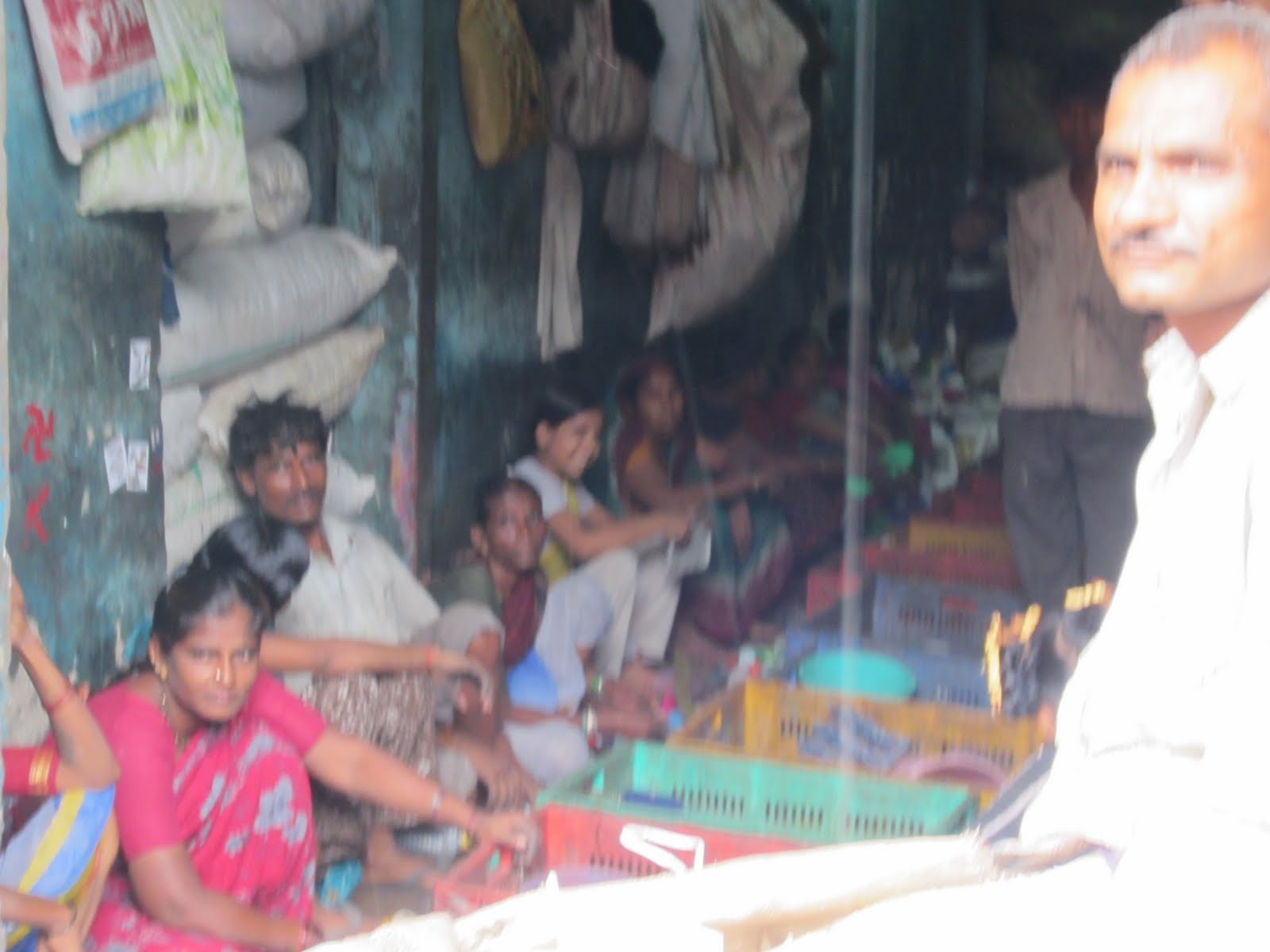
Our walk through Dharavi was a mind-blowing, humbling, thought-provoking, sensory overload. I found myself fascinated by the distinct industries and processes represented in each “hut” we passed. We spent much of our time in the recycling district. There is really no formal recycling industry in Mumbai because, as Mr. Shetty said, the economics just don’t work. So “rag-pickers” around the city bring garbage to Dharavi’s recycling centers, which have grown up over decades. Individual enterprises throughout the district handle various types of materials and parts of the recycling process. For example, in one multi-level building men disassembled cardboard boxes, fixed them with staples, and reassembled them for sale to small businesses. In another, women and men sat crossed legged in front of multi-colored bins, sorting small pieces of plastic to be grinded down to powder. The sorters could determine the chemical makeup of the plastic just based on the weight and feel.
But recycling isn’t the only industry in Dharavi. We also saw dye shops where people were making fabrics, welding shops making metal products, and people hand weaving brooms. And there were services to meet the workers’ needs – everything from convenience stores and restaurants to barber shops.
While the people of Dharavi have, over the last 75 to 100 years, created this huge economic engine, it is of course not without problems. Looking at it with a health lenses, we could not help but notice the occupational hazards everywhere. Men were welding and grinding metal without eye protection, gloves, or earplugs. People, including children, were touching dirty, potentially contaminated recycling materials without gloves. And workers were crouched in one spot, working with little light, for long periods of time. Beyond occupational hazards, there was abundant pollution, fruit covered in bugs being sold on the streets, and children running around barefoot. The government had recently demolished a large section of the slum that ran overtop a water pipeline, supposedly in an effort to avoid water contamination. However, they had left the oil and chemicals and garbage strewn on top of the pipes and it had a putrid smell coming up from it, so it did not seem safe at all. We smoke with Laxmi, one of the women features in The Real Slumdogs, National Geographic documentary we watched in class, and she explained how she had suffered from asthma right after the demolition.
ACORN India is doing great work to correct some of the problems in Dharavi. It works to educate workers about safety precautions they should take to avoid injury and chemical poisoning. It also provides children of Dharavi – many of whom must work to help feed their families – with educational opportunities including English classes, computer training, and even music lessons. Two boys from the ACORN program played drums for us, using recycled goods including plastic tubs as instruments. Perhaps most importantly, ACORN advocates for Dhavari citizens to protect them from injustice and abuse from the government and corporations. While as we discussed in a class meeting later, ACORN is not a true social enterprise, it is delivering valuable services that will hopefully help the next generation of Dharavi by educating children. I was truly humbled in meeting Mr. Shetty and hearing about the tremendous effort he and his small team of volunteers are making in Dharavi. Our glimpse into the real Dharavi is an experience I will never forget.
Here are some photos I took today.
The water pipeline and potential contaminants:

A recycling shop, that's a stack of old car bumpers:

The plastic sorters:
The ACORN boys playing drums and singing:


