Despite India's impressive economic growth over recent decades, the country continues to face challenges of poverty, illiteracy, corruption, malnutrition and terrorism. Approximately 70% of the country lives on less than U.S. $2.00 a day. Yet, India is a home to over 3 million NGOs. Many of these leaders are working tirelessly to improve the social conditions of the country.

"Introduction to Social Entrepreneurship: A Case Study of India" will challenge students to confront more advanced issues faced by today's social entrepreneurs. The field experience of the course will take students to Mumbai and India. Students will meet Social Entrepreneurs and NGOs working at all societal levels to understand grassroots' needs as well as the overall public health infrastructure in India.

Thursday, August 09, 2012

Who is Kiran Bedi?


We heard early in the morning about a change in the day's schedule. We were going to meeting with a group called India Vision Foundation, and perhaps their founder Kiran Bedi. All we were told was she is famous in India.

After Op ASHA and lunch roulette, we went to Ms. Bedi's offices where an associate gave us an overview of IVF. The foundation provides day care for children of incarcerated women. These children are fed and go to school near the jail and sleep with their mothers in their cells at night. 

Then Kiran walked in. Her office decorated wall-to-wall plaques, trophies, fan letters, photos of her with dignitaries.

Turns out, she's a HUGE deal in India, especially among youth (I later found out a friend who grew up in India would buy clothes to dress more like her!). She first came into the spotlight as the first woman officer in the Indian Police Service in the 1970s. Although she came from a privileged background, she went into the IPS believing the police were there to serve rather than to suppress. She gave Indira Ghandi, the prime minister at the time, a parking ticket! Not everyone thought it was funny. When her enemies tried quash her by reassigning her to oversee Delhi's biggest prison, she responded by completely transforming the prison system.

Since she retired from the IPS, Kiran has become an anti-corruption activist icon exposing corruption and atrocities perpetrated by the government. Giving a voice to the hundreds of millions of people who demand reform and seek a better life. She leads rallies of millions. There's a documentary about her narrated by Helen Mirren. She's been on TED multiple times. And she's sitting there chatting us up.
We asked a lot of questions about corruption in the government, her philosophy, and her background. I particularly liked this about leadership:
Build yourself, not to be a leader. Lead yourself first. Then you'll start influencing others. Practice constant inside-the-boot polish. 
This woman is a symbol for courage, perseverance, and truth. She's emerged through serious personal and professional battles, and continues to confront new challenges as she moves forward. To us, Kiran says she's comfortable with activism and is conflicted with the pull she feels toward politics. She's going to be prime minister of India one day.

12 dancing ladies

This past weekend in Bombay was both relaxing and exhilarating. On Saturday I met up with some friends for brunch. We walked from their apartment to the restaurant and it was an abbreviated way to see Bombay’s two-facedness within a 10-minute timeframe. On our walk, we navigated through traffic, puddles, trash mounds, people and even a family of rats feasting on something in the street. Ick. We arrived flustered, damp and ready for some good food. Walking into the restaurant, the Tasting Room, it was like stepping into a different world. Plush couches lined the walls, sangria flowed freely and it was open, comfortable and pretty much the stark opposite from the world just outside the doors. My friends in Bombay are total foodies and having done some serious traveling in their lives, they have learned how to quickly navigate to the best food a city has to offer. Their restaurant choice did not disappoint! The Tasting Room imports many of its meats and cheeses from Europe. They offer creative dishes that are exquisitely served. We were seated on some purple couches and I felt right at home! We ordered up some incredible tapas: watermelon with feta, fingerling potatoes, vegetable mac and cheese, skewers of chicken, hummus, mushrooms in a divine sauce and so on. Am I really in India, I thought? Unfortunately, my upset stomach from days past hadn’t fully worked its course, so we left after lunch and went back to relax a bit. Given my ailments, they were the best doctors a girl could ask for and set me up with some medication that really helped out. I returned to the hotel with some Indian ramen noodles (totally yummy!) and saltines and took it easy to prepare for the week. I hope we’ll make it back to the Tasting Room once more before I leave Bombay because it was such a diamond in the ruff!

One of our dishes at the Tasting Room 
Eating with Mel and Imran
The following evening, our group was invited to dinner at the home of Netra, the woman who was our right-hand lady in Bombay in scheduling our buses and helping us navigate the city. She lives in a lovely home just on the outskirts of the city. Her mother had prepared a feast for us and it was delicious! We sat out on their balcony and soon became the talk of the neighborhood. What were all these white people doing at Netra’s house? Perhaps what was even better than the food was the pre-dinner performance. Netra’s sister is a minor celebrity here in India because of her dance career. She practices traditional Indian dance and has traveled the world performing. She and a few of her friends performed one of their most famous dances and it was amazing! I mean, amazing. They moved so eloquently and in synch. Even their eye movements were in unison and portrayed with such intensity that you couldn’t help but get chills when watching. Then they invited all of us in a circle and showed us some Bollywood dance moves. Now, I am not much of a dancer, but I sure as heck tried! Dasi girl, anyone?! We danced around laughing and singing as a group. All of the harsh realities we had been trying to process from the week melted away and in that moment we felt like anything was possible – carefree laugher filled the balcony! It was probably one of the happiest moments I’ve had on this trip and a wonderful way to get to know some of my fellow students. I can only hope that if Netra and her family ever make it to DC someday that we could show them half as much fun and hospitality as they showed to us!

Learning some Bollywood moves!

Sanitation, TB and poor environmental health

The staunch scent of hydrogen sulfide from the sewage drains permeate the air in Mumbai and even worse so  in the slums we visited last week where the smell is enough to make you gag with nausea—especially when suffering from the expected bout of your own digestive issues.  As an environmental health student, I am struck by the overcrowded, poor conditions in the slums and the garbage piles on the streets—often wondering why there is such a lack of planning and sanitation services in the slums and the cities.  Simple int
erventions can prevent the number one cause of morbidity in this country—diarrheal disease.  However, sanitation services are not on anyone’s priority list—not the NGOs, the NIH nor the Indian government and frankly, I don’t get why such a necessary public health issue is being overlooked.   
India currently produces some of the brightest engineering minds in the world and there are innovative, cost effective, efficient sanitation systems out there that can recycle methane and reuse bio-solids as fertilizer—however, none are being used in India—to my knowledge.  Today, we met with Dr. Karin Bedi—Delhi’s famous police chief who restructured the prison system and is currently fighting against corruption in the Indian government.  She said many of the sanitation projects fall short of being implemented because the money allocated to them was consistently syphoned off by “politicians.” While I think corruption may play a significant role in the apathy surrounding this issue, I also think funding priorities often prioritize “sexy” diseases over those that are ubiquitous. 
In addition to lack of sanitation services, there are a number of issues that have some environmental health component to it.  For example, today we also visited Operations ASHA, an NGO providing Tuberculosis medications to identified cases in South Delhi.  OP-ASHA works with community leaders to identify TB cases and uses mobile technology to track and remind patients to take their medication. They receive a portion of their funding from the Indian government to implement the DOTS (Direct Observed Therapy-Short Course) program to reduce transmission of TB.  While OP-ASHA employs a novel strategy for addressing the highest rates of TB in the world and their model is proving to be successful, I felt the problem was not being addressed comprehensively. 
TB is an environmental health problem and when NYC was faced with this very issue in the early 1900s, they created the first public health policy requiring each apartment to contain at least two windows to increase ventilation and light into the dwelling thus reducing the propagation of the TB micro-bacteria.  It was the Light and Air standards that mainly contributed to the decreased in TB rates in NYC.  I am not sure why the Indian government does not try to improve living conditions in the slums—i.e. reduce overcrowded dwellings, increase ventilation and increase sunlight into the dwelling—the very conditions that perpetuate TB.  Even more discouraging is the fact that NGOs typically stay away from addressing sanitation issues because the Indian government is the designated responsible party for providing clean water and sanitation services.  Therefore any funding opportunity for sanitation services is viewed as redundant.    
I can’t pretend to understand the bureaucracy that is the Indian government that is so overburdened it relies on the NGO sector to pick up the slack.  However, it is time to put together the great minds at the various Indian Technical Colleges, some community and urban Planners, civil and chemical engineers and a few public health and health policy professionals to develop an implementation strategy for cleaning up the slums.  For a people that added the zero to the number line, not dealing with the antiquated issues surrounding sanitation only continues to hold India back and that just stinks….literally!

A Mother's Love

Last week in Mumbai we had the opportunity to meet with an amazing organization called SNEHA, the Society for Nutrition Education and Health Action. They work in Dharavi, one of the largest slums in Asia made famous by the movie Slum Dog Millionaire. Their programs center around women and include early childhood education, maternal and child nutrition, family planning services and support for intimate partner violence. SNEHA, which in Hindi, means "mothers love" was started by a pediatrician working in a large hospital near Dharvi who recognized through her patients that there was a lack of adequate services to address the major issues faced by  women and children in the slums. Our group was split up into three, and I had the opportunity to visit one of their programs focused on violence against women. One of the most surprising aspects of this program was the involvement of men in the community. A few were actively involved in the counseling and support groups SNEHA runs which was nice to see considering that violence against women is not seen as a serious issue here and more of just a way or life or cultural norm. The women in the support group were all very passionate and spoke confidently about their work in the community. It was a bit of a challenge to get all of our questions across through a translator, but I could tell by their body language that they were very engaged and excited. These women were so brave to have even come forward and spoken up about the violence going on in their homes, especially given the male dominated society that exists in India.

Another great program that SNEHA operates is a quilt making business that provides women from poorer areas of Mumbai with jobs making blankets, bags, rugs, pillow cases and other home good from donated fabric scraps. These women are trained to sew and provided with a steady source of income that allows them the ability to help provide for their families and seek work outside of the home. We had an opportunity to visit the warehouse, and the products they make are unbelievable, so beautiful and unique! We all scooped up some goodies to take home with us. Overall, I was very impressed with the work that SNEHA does in the community to empower women in the slums and help address vital women's health issues. 

Mumbai is not the real India


I love seeing the stark contrast between urban and rural India. Yesterday we took a three-hour bus ride north of Mumbai to trek through the rural villages with the organization Impact India. Our journey was an example of how India is a clash between two completely different worlds: modern Mumbai vs. rough rural. It was really important for me to get out of the city and see that there is this whole other side to India. Even being here only a week I think it is easy to slip into the mindset that India is all pollution, noise, Bollywood, shopping and becoming more Westernized by the minute. But, then you travel just a few hours outside of the city and realize that India is still a very much developing country where cows rule and stores are far and few between. Going to the rural areas with Impact India made me feel more connected to the country and its people.

I keep thinking about what the women from ATMA said, “Mumbai is not the real India…well it is but it isn’t”. That makes so much sense to me. Yes, Mumbai and city life is an important aspect to see but it doesn’t represent the vast majority. The first time I was in India I spent about six weeks living in various rural villages and it was there that I really got to understand the culture and love its people. Seeing Mumbai the words beautiful and lush do not come to mind and I was starting to question why in my journal last time I kept using those two words. Then yesterday we traveled for hours through the forest and I saw all the green and new life the monsoon season brought and I felt justified in my pervious conviction: India is beautiful. 


Wednesday, August 08, 2012

Delhi: The Cleaner City (Elizabeth)

Yes, Delhi is much cleaner than Mumbai and much calmer. Drivers do not honk their horns at every moment and I can step outside without smelling trash everywhere. It has been a packed day and a half in Delhi. Yesterday afternoon, we visited the US Embassy to meet with the NIH representative in India to learn about what research projects are being funded. The NIH has a large portfolio in India ranging from maternal and child health to new technology development. We discussed that many challenges that researchers face in India, both Indian and American. The Indian government is slow to process requests and it can take years for funding to be approved.


This morning we met with Operation ASHA (http://www.opasha.org/), an organization focused on treating TB patients in India. India has a growing problem with TB, which is complicated by the strict medical care needed to treat the disease. Operation ASHA uses innovative mobile technology to track patients using digital finger prints in slum areas to make sure they take their medication. All of the medication is provided by the government. The program uses the DOTS practice, meaning that patients must take their medication in front of an ASHA provider. If a patient does not show up for treatment, the mobile technology alerts the provider so that they can find the person and bring them their medication.


After a quick lunch, we had an incredible opportunity to meet with Kiran Bedi, the first female in India’s police and an activist who has become very famous for her work in government anti-corruption. She is an inspiring person to listen to. She has spent her entire life dedicated to making India the country she knows it can be. Her anti-corruption movement has grown into millions of people, and one of their goals is to change the political landscape of the country in the 2014 elections. On the side, she also has two foundations, one of which works with children living in the prisons because their mother is there. Yes, that is correct, in India children can live with their mothers in prison until the age of 6!

Part of the problem in trying to help fix problems in India is that corruption in the government takes money away from needed infrastructure. This is a theme that our group has seen with all of the organizations we have visited. Dr. Bedi has been working tirelessly to uncover proof of these schemes and bring them to the public. When we asked her if she plans on running for office she said no, but I suspect we will see her as Prime Minister one day soon.

It was a long day, but one that has brought me a great amount of respect for India and the people here working to help those in need in the face of tough political circumstances.

Whirlwind in India


Tuesday, July 31, 2012       

            “We are in the business of heroes.”  It is not everyday you hear a line like this, but these were the exact words I heard on my first full day in India.  After more than 48 hours of being rerouted on planes, I landed in the long-awaited destination of Mumbai, where the rest of my classmates were waiting with wide smiles, open minds and an eagerness you only see on the faces of those visiting a new and unknown place.  Yes, it was Tuesday morning, and after applying for this trip more than 6 months ago and taking several weeks of classes in D.C., we were all ready to learn about social entrepreneurship at ground zero.

            So back to what I was saying: all that business about heroes.  In the U.S., we tend to think about heroes in the form of the newest comic book character or action figure to hit the big screen.  Last month Spiderman, this month Batman.   Flashing lights, spandex suits, and let us not forget superhuman powers.  These are the types of fictional heroes generated through popular culture, who gain recognition and appeal at mass levels.  But here in the nonprofit sector of India, we are learning about a new kind of hero.  One you do not see plastered on a billboard the size of a mountain or hinged at the center of a multimillion-dollar industry.  In a city with more than 9 million individuals living in slums, today’s heroes in Mumbai are those individuals working to create sustainable social change and eradicate poverty at the grassroots level.
 
            If they are not local farmers working to produce honey to raise money within their communities, they may be select individuals with innovative ideas for social entrepreneurship.  Be! Fund is one of the nonprofit organizations we met with during our first full day in India, using a media platform to reach people throughout different communities in Mumbai.  Be! Fund seeks individuals with fresh ideas to spur social business development within their own communities, based on personal experiences and observations.  This organization runs on the theory that such individuals are the most aware of pertinent issues within their communities, and the most knowledgeable about ways to solve rising problems with available resources.  In this sense, Be! Fund is in the business of heroes.
           
            Another organization we met with is called Under the Mango Tree, a nonprofit organization following the idea of “Bees for Poverty Reduction.”  Local farmers are able to participate in farming cooperatives, and through the program are able to increase their annual incomes substantially.  This initiative establishes a buyback arrangement for the honey that is produced, and Under the Mango Tree sells organic honey produced by local Indian farmers.  Bees are a local, natural resource, and producing honey is not detrimental to the environment.  Under the Mango Tree runs a program using available resources to spur local income among farmers in order to create social entrepreneurship.  In addition to involving local farmers, Under the Mango Tree aims to incorporate community-training programs to expand the business skills of individuals within the community for sustainable development and business expansion.

            The third organization we met with, called ATMA, works in the educational arena to partner with and strengthen already existing nonprofits and impact the system.  ATMA currently relies on word-of-mouth strategies to recruit partner organizations, emphasizing the fact that an organization’s credibility and reputation are important elements of the nonprofit sector.  This is especially true in India, where over 3 million nonprofit organizations are all working throughout the country on a wide array of social, economic and political issues.  In its role, ATMA highlights the need for cooperation and communication among these separate entities, especially in the realms of health and education.

            Among the three organizations we met with this day, it was apparent all were seeking innovative business incentives with ideals of community development in mind.  It was really interesting and inspiring to meet the unique representatives who took the time to come and speak with us about their organizations, and how they became involved in their work in the nonprofit sector.  It was even more interesting to note all of these individuals were women of various ages.  Many of them recognized a need for social change at some point in their lives, either earlier or later, and decided to become part of this movement. 

            As the population in Mumbai soars, the government can only do so much.  This is why the nonprofit sector is so important to provide assistance and instigate sustainable community development where the government and private sector fall short.  Whether they are the local individuals creating change within their communities or the staff members working at nonprofit organizations supporting social development, it is apparent that heroes come in many forms.

Wednesday, August 1, 2012


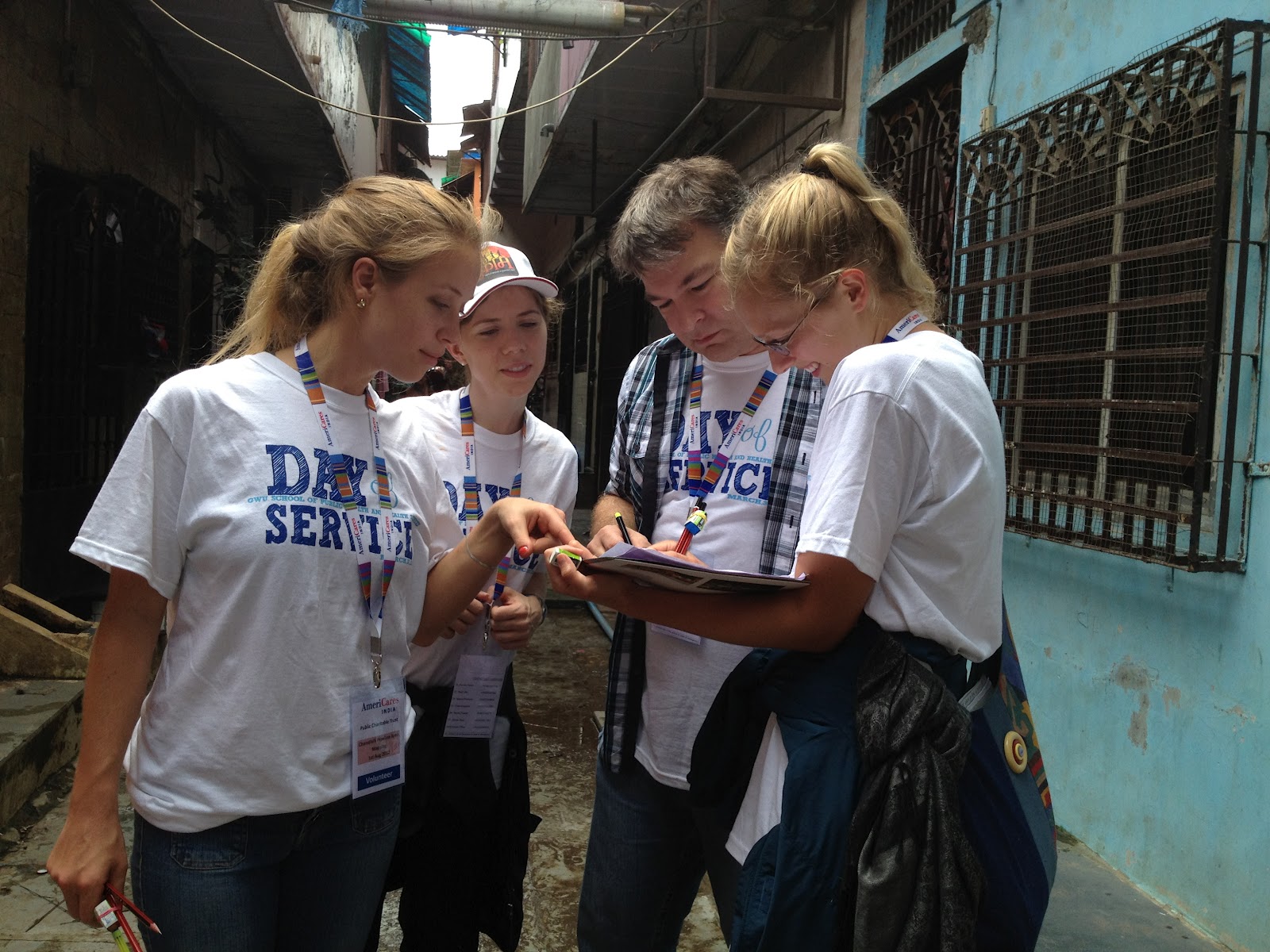
            Today we went to visit an organization called AmeriCares, working to improve the healthcare system throughout Mumbai’s slums.  After meeting in the headquarters, we were split into several teams and assigned different sections of a particular slum to map out.  This may seem like an simple task, but when most streets are not clearly identified, and the only thing you are working with is a satellite image of the area, the task can be somewhat meticulous.  As the map drawer, I was assigned the job of drawing out the different streets and marking off the number of homes, shops and other landmarks, as well as the number of footsteps in between each lane.  Other members of my group had the arduous task of counting out these footsteps and doorways. 

            At first it seemed like we would be able to get this done in a snap, but as we turned more corners, things began to look the same.  Had we been here before?  Was that yellow building the same one I passed 5 minutes ago?  How do people who live in this community remember their way around, I wondered as I watched children running through the streets without a second thought in regards to direction.  These were all questions that began to fill my head as the temperature rose and our map looked more and more complicated.  Luckily, we had several members of the AmeriCares team by our side to help direct us, and who had obviously done this before, as one of the major goals of the organization is to map out the entire community in this manner for efficient health care access and mobilization.  If not for these individuals, I fear I would have been lost within minutes.

            Towards the end of the mapping exercise, one of the AmeriCares team members introduced us to a gentleman.  She said he was one of the AmeriCares community workers, and that he usually does these types of mapping exercises on his own.  This really put into perspective how important community involvement is in the work of nonprofit organizations, as these individuals know the areas well and can complete these tasks with efficiency and skill.  AmeriCares is a multifaceted organization generating social change at the community level, but this work would not be possible without the cooperation and involvement of the local members of the community the organization is working in.

Friday, August 3, 2012

            Dharavi. 

            For weeks we have been discussing visiting the most populated slum in India, Dharavi.  Sometimes you hear about things ahead of time or see images through the media, and you think you are prepared for what lies ahead.  This was the same slum where potions of the popular movie “Slumdog Millionaire” were filmed.  We knew it would be crowded.  We knew it would be dirty.  As much as you try though, nothing can prepare you for the real life image of the poverty in Dharavi that exists in mass. 

            We got an early start to the day and headed over to the hospital on the outskirts of the slum, where an organization titled SNEHA operates out of in part.  SNEHA stands for the Society for Nutrition, Education and Health Action: Healthy Women and Children for a Healthy Urban World.  Once again, I was moved by the men and women involved in this organization, and the high level of commitment they possess for social change and health promotion. SNEHA aims to empower and educate women and children in order to improve health outcomes throughout the community. 

            One program in particular stuck out to me, centered on reducing the occurrence of domestic violence throughout the slum.  Raising the issue of violence and empowering women to stand against it is one of the main drives within this program.  It was disheartening to learn how isolated women become by all members of their community when they stand against domestic abuse.  We were able to actually go into Dharavi and meet with peer educators trained to counsel women and support them in their stance against violence.  Once again, it was inspiring to see both men and women, without much formal education, working as peer educators, and to witness their compassion and motivation to lower rates of abuse within their own communities. 

            While walking through Dharavi, I became increasingly aware of the number of people living in the slum.  The narrow and busy walkways gave way to countless shops and a seemingly endless number of doorways leading into crowded homes.  It almost felt as though we were traveling through a maze, and if I lost my group, I would have no idea how to get back to the hospital.  Walking through the slum highlighted the lack of governmental involvement in the area, and need for nonprofits, such as SHEHA, to work towards community development.  Although conditions in the slum are harsh, it was also inspiring to hear stories of individuals helping their neighbors within the community in regards to child and financial support.  Stories like these remind us that organizations like SHENHA are working to improve conditions in areas where people have the incentive, yet are struggling to support one another.


Sunday, August 5, 2012


            Today we were able to do some sightseeing at these ancient caves called the Elephanta Caves.  Before coming to India, people continually mentioned to me how spiritual the country is, but until I was standing before the massive sculptures carved into the walls of the caves, I was not truly aware of how important religion was and continues to be in this country.  The caves were dark and damp, but not frightening.  It was quite an experience to stand in such an old space and take in all the history, as the tour guide narrated stories to us about the various Indian gods and how Portuguese colonists decimated the caves centuries ago.


            In order to reach the caves, we had to walk up several staircases through an outdoor market.  Monkeys were running above us, besides us and below us.  I was able to purchase a painting that contains bright colors, as though it appeared out of a dream.  At the bottom of the stairs, my friend was eating some grilled corn on the cob until a cow came up from behind and surprised her.  She immediately threw the corn on the ground, and from that moment on, the corn belonged to the cow and monkeys weaving between stands in the market.

            This evening, we were invited to attend dinner at our trip coordinator’s house.  Netra’s entire family was extremely hospitable and setup the open porch for our entire group.  Her sister is a professional dancer in India, and some of the girls put on a performance for us.  It was a wonderful experience, as each dance told a story about Indian religion and culture.  At the end of the performance, we were invited to join in the dancing, which was fantastic.  We danced around in a large circle, laughing and throwing our hands up in the air to traditional Indian music.  Even Dr. Vyas and Dr. Parrish joined in.  If nothing else, I noticed how reinvigorated all the girls seemed tonight based on the smiles and funky dance moves they produced.


Monday, August 6, 2012

            Seven AM, we meet in the lobby and board the bus.  It’s time to go.  The mindset of today:  Let’s do this.  We are venturing into rural India for the first time on this trip, and spirits are high.  More importantly, we get to meet with members from Impact India, an organization working to improve health care delivery and health outcomes in rural villages outside of Mumbai.  The information session begins as we hit the road, with a question and answer session on the bus.  With 5 sites to visit in one day, there is literally no time to waste.
           
            Among the places we visited, the site that stuck out to me the most was the first school we stopped in.  Inside, we witnessed the children carrying out an activity aimed to improve health and sanitation among classmates.  The children have been allowed to elect their own health monitors amongst themselves; one for the girls and one for the boys.  The health monitor, in turn, runs physical and audial evaluations of their classmates regarding appearance, doctor visits, etc.  The children seemed to be taking this activity extremely seriously, as the monitor checked fingernails, ears and asked questions about health outside of school, and kept a log of all information collected.  Not only was the activity allowing the children to manage control of their own health, it was also teaching them about an important political process, as they were able to choose their own health monitors, who then chose their own assistants.  It appeared to be a very effective educational tool to promote health and leadership within a school.

            Another stop we made was to visit a community meeting for women surrounding health and other issues.  Although the women were a bit shy to speak out, it was really interesting to see how many voluntarily attended this monthly meeting, and how they seemed to regard health as an important aspect of their lives.  It was noted that men are not usually invited to such meetings because women’s health is such broad topic for discussion.  The fact that these female attendees would not open up around us made it clear they may not be as candid as they are alone if men did attend these meetings.  Either way, it was noteworthy to recognize the role women play in maintaining their own health and that of their children at a community level, and their commitment to do so.

            As the rain came down, we pulled up to our last stop: a rural clinic.  We were able to take a brief tour of the facility, and then sit down and have an informational session with one of the doctors who work there.  As it turns out, the doctor we met in one of two who lives on the grounds 24 hours per day, and helps to serve thousands of patients annually.  As the government subsidizes this particular clinic, patients only have to pay 5 rupees per general visit.  Many women from the area come to this clinic to have their babies delivered.  It was somewhat daunting to see the relatively small size of the clinic in relation to the number of patients it serves.  This seems to be the norm though, as I have been able to visit rural clinics in South Africa and Nicaragua, and I am always surprised by their size relative to patients served.

            As the day wrapped, up, it was clear that we had just witnessed public health in action.  As a student, it is can be easy to lose sight of why you became involved in a certain field if you spend all of your time buried in books in the library.  Coming to India so far has reminded me of the role public health plays in the lives of an enormous amount of people.  Seeing these kinds of efforts in person revitalizes the notion that public health, whether it is epidemiology or child and maternal health, has the potential to improve the world through a community-oriented approach.  In order to continue working in this field, it is critical to ascertain the idea helping one person can generate an enormous impact.  This is where public health intervenes with social entrepreneurship.  Through innovative programs equipped with peer education, the potential exists to create economic development and improve health outcomes throughout an entire community.